What data privacy laws apply to clinic patient queues, and is the data safe in the cloud?
The law of the country the clinic is in — HIPAA in the US, the GDPR in the EU, and the personal data protection laws of Jordan, Saudi Arabia and the UAE — and under most of them a patient's name beside a doctor's counts as health data, the most protected kind. In the cloud, the data is safe only if each clinic's data is isolated and every request is authorised on the server, not by hiding what the browser may ask for.
By ATA ATA, practising optometrist · Last updated:
Which privacy laws apply to a clinic's queue?
A queue holds patients' names and which doctor they are waiting for, and in most places that makes it personal data about health, handled under the strictest rules a country has. Which law applies depends on where the clinic is, not where the software company is:
| Where the clinic is | The law | What it means for a queue |
|---|---|---|
| United States | HIPAA Privacy Rule | Calling names aloud and sign-in sheets are allowed, if only what is necessary is shown — never the reason for the visit. |
| European Union | GDPR, Article 9 | Health data is a special category; processing it to provide health care is allowed, under the Article's conditions and safeguards. |
| Jordan | Personal Data Protection Law No. 24 of 2023 | In force since March 2024. Health data is sensitive data; patients can ask to access, correct or erase theirs, and breaches must be reported. |
| Saudi Arabia | Personal Data Protection Law | In force since September 2023 and enforced by SDAIA. Health data is sensitive data, and transfers outside the Kingdom are restricted. |
| United Arab Emirates | Federal Decree-Law No. 45 of 2021, and Federal Law No. 2 of 2019 on ICT in health fields | Health data is sensitive, and the health ICT law restricts storing health data outside the UAE except in approved cases. |
The question worth asking a vendor
Ask a vendor where the access check happens, not whether the data is encrypted — everything is encrypted, and that answer tells you nothing.
If a system decides what you may see in the browser, then the browser is the security. Anyone who can open the developer console can ask for something else, and the server will answer, because the server was never asked to have an opinion. This is the most common way a small clinic system leaks, and it is invisible from the outside.
In QueueCare the check is on the server, on every request, without exception. A station asking for a queue that is not its clinic's does not get a filtered answer; it gets refused.
Isolated means isolated
One clinic cannot read another's queue, patients, or records, by any route — not through a URL, not through a guessed identifier, not through a station left signed in.
The waiting-room screen is held to the same rule, which is worth saying because it is the one device in the building with no person attached to it. A screen is scoped to the clinic it belongs to and can show nothing else.
What a queue system should not hold
QueueCare stores no clinical records. No notes, no diagnoses, no prescriptions, no history.
That is a design decision rather than a missing feature. A queue needs a name, a place in line, and which doctor. Adding a patient's medical history to that would make the system more valuable to attack and no better at the job it exists to do. The safest data is the data that was never collected.
How to protect patient data in a clinic queue system
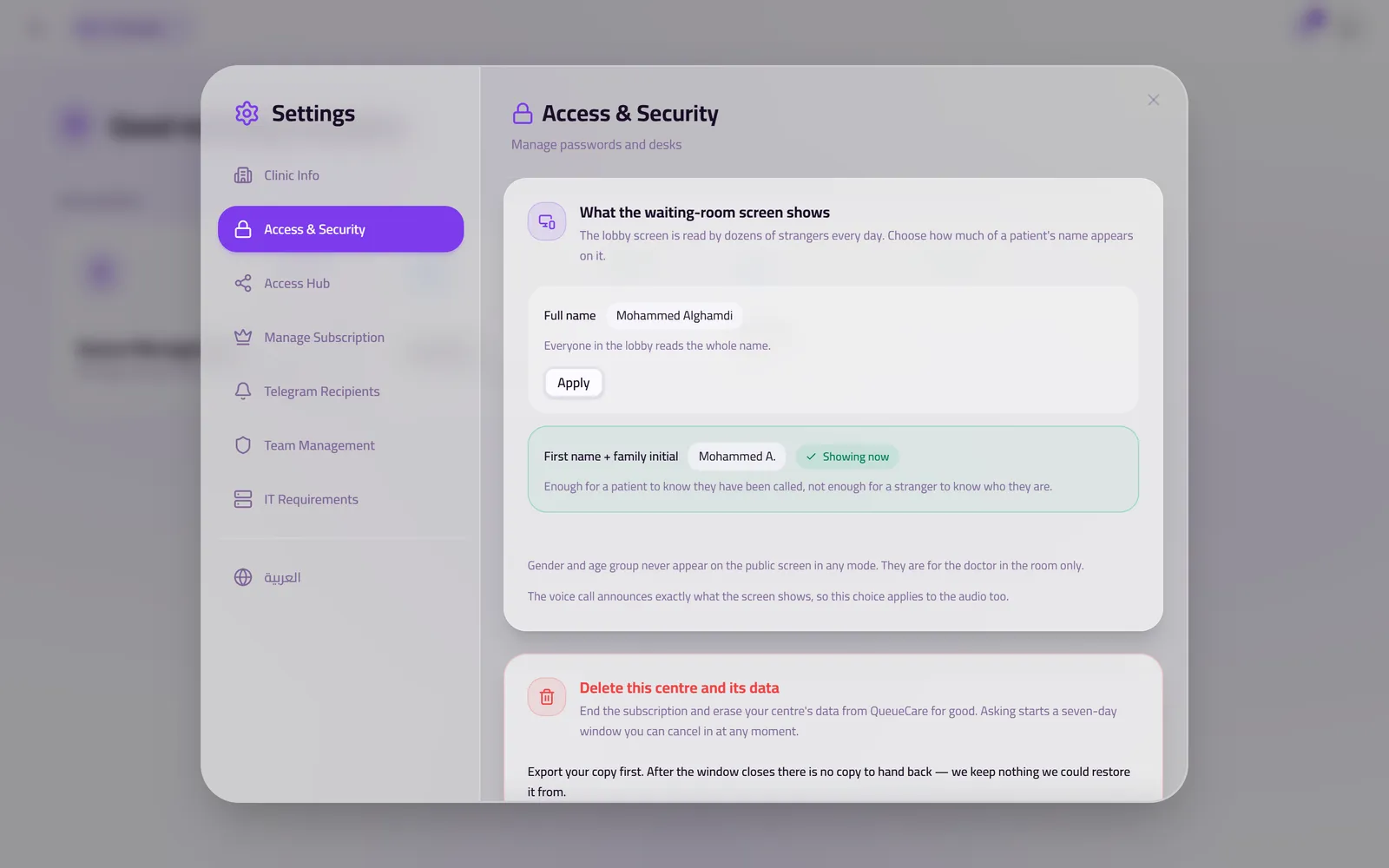
Collect only what the queue needs, keep a patient's reason for visiting off anything others can see, limit who can open the data, and know where it is stored. Those four habits hold under every law above. On the waiting-room screen, show no more of a name than the room needs; QueueCare lets a clinic shorten it in Settings → Access & Security.
QueueCare's answer to the last one is on its security page, which names each company that holds the data and where: the database runs on AWS through Convex, and the application on Google Cloud in Virginia. A clinic in a country that restricts storing health data abroad, such as the UAE, should check with its health authority before putting patient data in any cloud system hosted outside the country. This guide is general information, not legal advice.
How QueueCare puts this into practice
Three settings under Settings → Access & Security carry the habits above. The first decides how much of a name the waiting-room screen shows: the full name, the first name and family initial, or — in a clinic that prints tickets — the queue number alone. The spoken call says exactly what the screen shows, and a patient's gender and age group never appear on the public screen in any mode.
The second decides whether QueueCare's own staff may open the centre's data at all. A centre that signs up today starts with that switched off, and every change and every access is written to its audit trail. The third gives the data back: a full copy can be exported at any time, and asking for the centre to be deleted starts a seven-day window in which the request can be cancelled.
The one number this site publishes
The counter on the home page — the total number of patients moved through QueueCare — describes the platform as a whole and identifies nobody. No clinic name, no patient, no location, no breakdown.
It is the only figure published openly. A vendor that publishes usage statistics per client has decided your patient volume is its marketing material.
Questions clinics ask before they start
Can one clinic see another clinic's patients?
No. Every request is authorised against the clinic it belongs to on the server, so a request for another clinic's data is refused rather than filtered.
Does QueueCare store medical records?
No. It holds the queue, check-in, and the timing of each visit. There are no clinical notes, diagnoses or prescriptions in it.
Who is the data controller?
The clinic. QueueCare processes patient data on the clinic's behalf and under its instructions; the clinic decides what is collected and why. The privacy policy sets this out in full.
What about the waiting-room screen, which nobody signs in to?
It is scoped to its own clinic and authorised the same way as any other station. It can display that clinic's queue and nothing else.
Is it legal to call patients' names in the waiting room?
Under the US HIPAA Privacy Rule, yes: the US Department of Health and Human Services says physicians' offices may call out names, as long as what is disclosed is limited and reasonable safeguards are in place. Other countries' rules differ; calling a number instead of a name avoids the question.
Sources
- May physician's offices use patient sign-in sheets or call out the names of their patients in their waiting rooms? (FAQ 199) — U.S. Department of Health and Human Services, 2022
- Art. 9 GDPR — Processing of special categories of personal data — General Data Protection Regulation (EU) 2016/679, via gdpr-info.eu, 2016
- صدور قانون حماية البيانات الشخصية في الجريدة الرسمية — Jordan News Agency (Petra), 2023
- Data protection laws in Jordan — DLA Piper, Data Protection Laws of the World, 2026
- Data protection laws in Saudi Arabia — DLA Piper, Data Protection Laws of the World, 2026
- Data protection laws in the United Arab Emirates — DLA Piper, Data Protection Laws of the World, 2026
Related guides
- Can a queue system connect to the patient database we already have?
Often, yes — QueueCare ships a local bridge that reads an on-premise SQL Server or Oracle database, so file numbers and names come across instead of being retyped.
- What is the best way to call the next patient in a waiting room?
Say it out loud and show it at the same time. A spoken announcement reaches the patient who is not looking; a screen reaches the one who did not hear.
- What should I ask before choosing a clinic queue system?
Five things decide whether a queue system fits a clinic. Where the security check happens, what hardware you are buying, what the patient without a smartphone gets, how many can work the queue at once, and what three years cost.
See it with your own queue in it.
Open the demo and you are standing inside a working clinic — doctors mid-session, patients in line, screens calling names. Nothing to install, nothing to sign.
Open the live demo