What are the best team communication tools for doctors and reception staff?
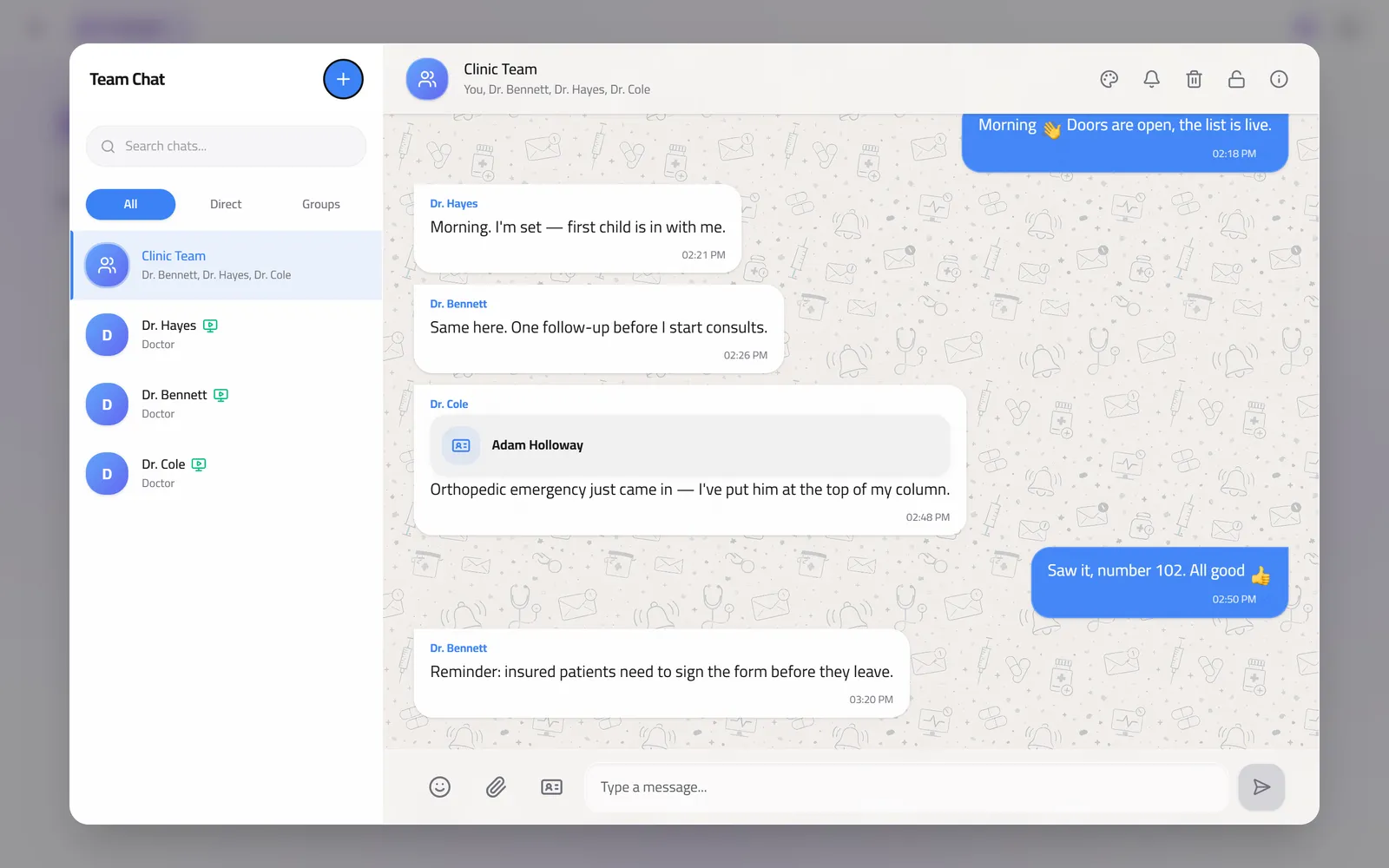
The one that knows which patient you mean. Walking over and phone calls interrupt a consultation, and a WhatsApp group puts patient names on personal phones. A chat built into the queue lets a doctor's room and the desk message each other about the patient card they are both looking at, without leaving the board.
By ATA ATA, practising optometrist · Last updated:
What doctors and reception actually need to say
Listen to a clinic morning and the messages are short and nearly all about one patient in the queue: is number 14 still with you, send the family in after this one, the patient in room two needs a follow-up booked, the report for the patient who just checked in has arrived.
That shapes what a good tool is. It has to reach the other person without stopping what they are doing, and it has to say which patient without anyone typing a name and hoping it is the right one.
Why interruptions are worth avoiding
Interruptions have a cost in clinical work. In a study of 98 hospital nurses giving 4,271 doses of medication, each interruption was associated with a 12.7% increase in clinical errors. That was medication rounds on hospital wards rather than a consultation, but it is the reason a message that waits silently beats a phone that rings in the middle of one.
The options, side by side
Clinics pass messages between doctors and reception in five ways: walking over or calling out, the phone or intercom, a WhatsApp group, a general team chat, or a chat inside the queue. Most use one or more already; they differ in whether they interrupt, whether they know the patient, and where the patient's name ends up.
| Option | Interrupts the consultation | Points at the exact patient | Stays off personal phones | Another app beside the queue |
|---|---|---|---|---|
| Walking over or calling out | Yes | Only if the name is said aloud | Yes | No |
| Phone or intercom | Yes — it rings | Only if the name is said | Depends on the phone | No |
| A WhatsApp group | Not if muted | Only if the name is typed | No — usually personal phones | Yes |
| General team chat (Slack, Microsoft Teams) | Not if muted | Only if the name is typed | Yes, on clinic devices | Yes |
| Chat inside the queue (QueueCare) | No — it waits on screen | Yes — attach the patient's card | Yes — on the clinic's own screens | No — it is in the queue screen |
What a chat built into the queue can do
In QueueCare the chat opens from the same screen as the board, at the reception desk and in each doctor's room. It carries what a clinic morning needs:
- Direct messages between a room and the desk, and groups for the whole team or one shift.
- Patient cards attached to a message, so “is he still with you?” points at the exact patient on the board.
- Photos and documents, @mentions, replies in a thread, and reactions for a quick acknowledgement.
- Read receipts, so the desk knows the doctor has seen the message without asking again.
- Groups where only the group's admins can post, for announcements that should not turn into a conversation.
A few rules that make any tool work
Whichever tool a clinic chooses, the habits matter as much as the software: agree who answers the desk's messages when the doctor is with a patient, keep messages to what the other person needs to act on, and keep patient details inside the clinic's own systems rather than on personal phones.
Questions clinics ask before they start
Can a doctor message reception without leaving the consultation?
Yes. The chat opens in the doctor's room view, and the message waits on the desk's screen instead of ringing.
Does reception know when the doctor has read a message?
Yes. Messages show read receipts, so nobody has to walk over to check.
Is chat included, or an extra?
Team chat is included in the Pro plan, with the analytics and the screens.
Sources
- Association of interruptions with an increased risk and severity of medication administration errors — Archives of Internal Medicine (Westbrook et al.), 2010
Related guides
- Can several receptionists work the same clinic queue at once?
Yes. Each desk, doctor's room and kiosk signs in as its own station. Two receptionists on the same queue see each other's changes immediately, and nobody pays for a login per person.
- What is the best way to call the next patient in a waiting room?
Say it out loud and show it at the same time. A spoken announcement reaches the patient who is not looking; a screen reaches the one who did not hear.
- How do you track average wait times per doctor, per day?
Record two times for every patient — when they arrived and when the doctor started with them — and average the gap by doctor, day by day. A queue system that timestamps both does it automatically; on paper it takes a log sheet at the desk and someone to total it every evening.
See it with your own queue in it.
Open the demo and you are standing inside a working clinic — doctors mid-session, patients in line, screens calling names. Nothing to install, nothing to sign.
Open the live demo