How do you track average wait times per doctor, per day?
Record two times for every patient — when they arrived and when the doctor started with them — and average the gap by doctor, day by day. A queue system that timestamps both does it automatically; on paper it takes a log sheet at the desk and someone to total it every evening.
By ATA ATA, practising optometrist · Last updated:
The two times that matter
A patient's wait for a doctor is the time between arriving and that doctor starting the consultation. Everything else is detail, but three details decide whether the number means anything:
- Arrival is when the patient checked in, not when they booked. For booked patients, keep the appointment time too, so an early arrival can be told apart from a late doctor.
- A patient seen by two doctors waits twice. The wait for the second doctor starts when the first consultation ended, and belongs to the second doctor's line.
- The start is when the consultation began, not when the patient was called. A call that nobody answers is not the end of the wait.
Doing it by hand
It can be done with a log sheet at the desk: one row per patient, with the ticket number, the doctor, the arrival time, the time they went in, and the time they came out. At the end of the day, subtract, group by doctor and average.
It works for a week, and that is its weakness. The busiest hour is exactly when nobody has time to write, so the log is most incomplete where the wait is worst. Use it to find out whether there is a problem, not to run the clinic on.
Reading the numbers
An average per doctor per day is where to start, not where to stop.
- Count the long waits, not only the average. How many patients waited more than 30 minutes — the limit most often cited — or more than an hour says more than a mean.
- Put the wait beside the consultation time. A doctor whose patients wait long because each consultation runs long is a different problem from a doctor whose line is simply longer than the next one.
- Compare the same doctor across days before comparing doctors with each other. Doctors seeing different kinds of patients will not have the same numbers, and should not.
- Look by hour. Most clinics do not have a slow day; they have a slow hour, and the fix for ten o'clock is not the fix for four.
Ways to track it
The methods differ mostly in who does the recording, and whether it still happens on the busiest day.
| Method | Arrival time | Start of consultation | Average per doctor | Daily effort |
|---|---|---|---|---|
| Paper log at the desk | Written by hand | Written by hand | Totalled by hand | Every patient, plus the evening sums |
| Spreadsheet | Typed in | Typed in | A formula | Every patient |
| Asking patients afterwards | From memory | From memory | Rarely possible | A survey to run |
| Queue system timestamps (QueueCare) | Recorded at check-in | Recorded when the doctor starts | Calculated for you | None |
Which hours of the day are busiest?
Count arrivals by the hour patients checked in, not by appointment time, because walk-ins and late arrivals are exactly what makes an hour busy. Then compare the same weekday across several weeks: one day's peak can be an accident, but the same peak four Tuesdays running is a pattern worth staffing for.
Busy is not the same as slow. An hour with many arrivals that a second doctor absorbs is fine; an hour that leaves patients waiting past your limit is the one to fix.
Which numbers to review for each doctor at the end of the day
Two numbers per doctor, read together: the average wait before that doctor started with a patient, and the average length of that doctor's consultations. A long wait with short consultations points at the size of the line or the order it was worked in; a long wait with long consultations points at the schedule.
Add how many patients waited more than an hour that day, and read each doctor against their own previous days before comparing them with anyone else.
How QueueCare tracks it
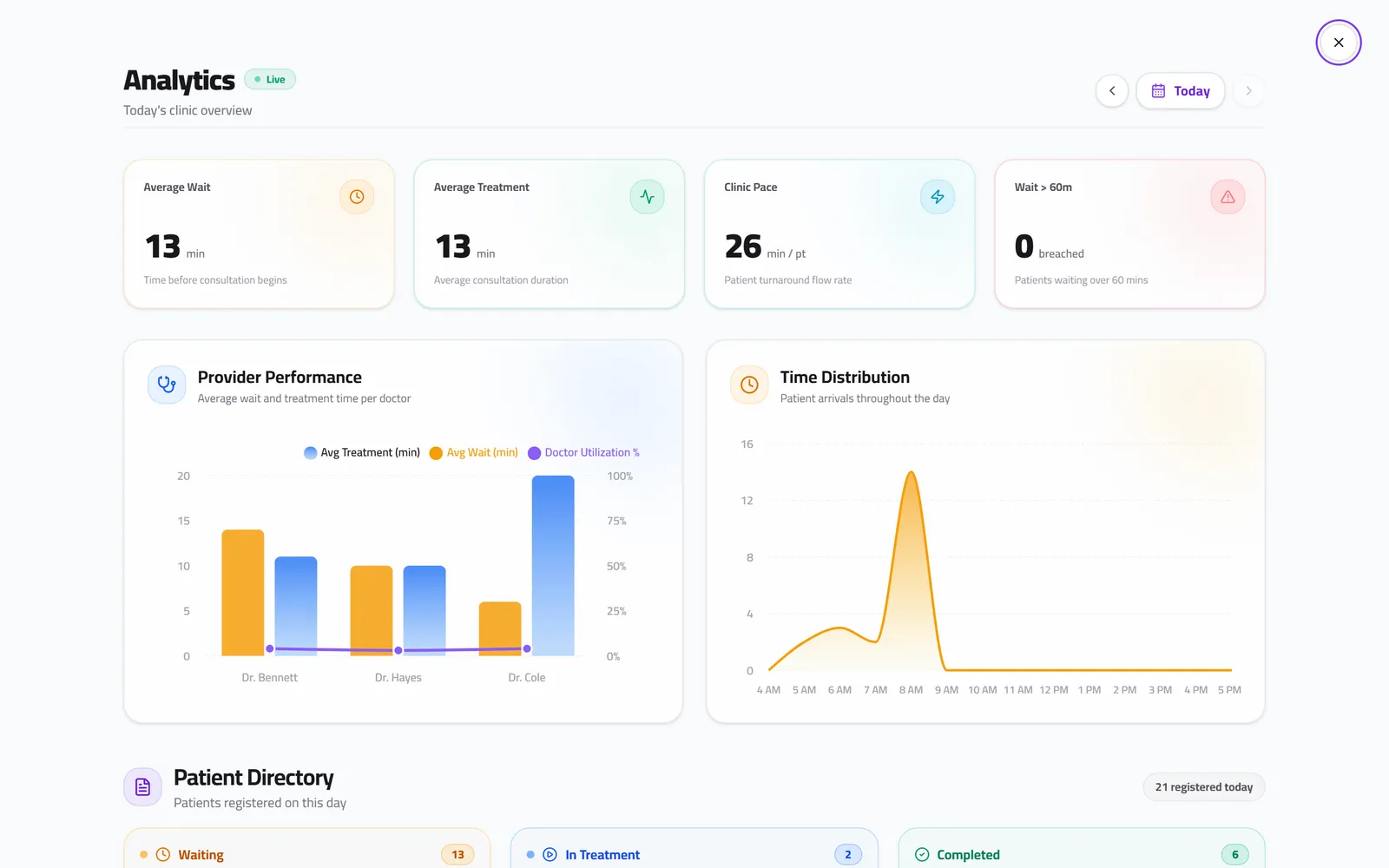
QueueCare records the check-in time of every patient and the start and end of every consultation, because those are the moments reception and the doctors already mark on the board. From them, the day's analytics show each doctor's average wait — from arrival, or from the end of the previous doctor's consultation — beside that doctor's average consultation time and how busy their room was.
The same screen charts how many patients arrived in each hour of the day, beside the clinic's average wait and how many patients waited more than an hour, and any past day can be opened to compare it with today.
Questions clinics ask before they start
What is a good average wait per doctor?
The limit most often cited is 30 minutes in the office. The National Academies advise each clinic to set its own target from its demand and capacity, so track the trend for each doctor rather than chasing one number.
Should time in a test or with a nurse count as waiting?
Decide once and keep it consistent. In QueueCare a patient's wait is time in the clinic not spent in a doctor's session; for the per-doctor figure, it is the time before that doctor started.
Can I compare doctors fairly?
Only if they see similar patients. Start by comparing each doctor with their own previous days, and look at wait and consultation time together.
Sources
- Transforming Health Care Scheduling and Access: Getting to Now — Chapter 2, Issues in Access, Scheduling, and Wait Times — National Academies of Sciences, Engineering, and Medicine (Institute of Medicine), 2015
- Transforming Health Care Scheduling and Access: Getting to Now — Chapter 5, Getting to Now — National Academies of Sciences, Engineering, and Medicine (Institute of Medicine), 2015
Related guides
- How do you reduce patient wait times at a clinic?
Measure the wait per doctor and per hour first, then fix what the numbers show — usually doctors starting late, patients arriving long before they can be seen, and one doctor's line overloaded while another is free. Showing patients where they stand does not shorten the wait, but it makes it far easier to bear.
- How long should patients wait before seeing the doctor?
No longer than 30 minutes is the standard most often cited: it is the office-wait limit used by the US Military Health System and California's managed-care regulator. Recent US survey data puts the typical waiting-room wait at about 13 minutes. Patients judge a wait less by its length than by whether they know how long it will be.
- What are the best team communication tools for doctors and reception staff?
The one that knows which patient you mean. Walking over and phone calls interrupt a consultation, and a WhatsApp group puts patient names on personal phones. A chat built into the queue lets a doctor's room and the desk message each other about the patient card they are both looking at, without leaving the board.
See it with your own queue in it.
Open the demo and you are standing inside a working clinic — doctors mid-session, patients in line, screens calling names. Nothing to install, nothing to sign.
Open the live demo