How do you reduce patient wait times at a clinic?
Measure the wait per doctor and per hour first, then fix what the numbers show — usually doctors starting late, patients arriving long before they can be seen, and one doctor's line overloaded while another is free. Showing patients where they stand does not shorten the wait, but it makes it far easier to bear.
By ATA ATA, practising optometrist · Last updated:
Measure the wait before you change anything
Every intervention that worked in the studies below started from a number. The National Academies' recommendation to care sites is to “continuously assess and adjust the match between the demand for services” and their capacity — which cannot be done without knowing, hour by hour, where the demand is.
The minimum is the time from each patient's arrival to the moment a doctor starts with them, recorded for every patient and split by doctor, by hour and by weekday. A single clinic-wide average is exactly the figure that hides the problem: the Tuesday morning when one doctor's patients waited an hour disappears into a day that averaged twenty minutes.
The causes that keep coming back
A study of outpatient clinics in Saudi Arabia by Almomani and AlSarheed traced long waits to five sources: how appointments are typed, how tickets are numbered, doctors arriving late, patients arriving early, and how patients are distributed across doctors. None of them is about working faster inside the consultation room.
Their models put numbers on it. Solving late doctor arrival cut clinic service time by up to 20%. Handling early-arriving patients reduced total waiting time by 30.3%. Better distribution of patients across doctors produced a 54.2% improvement. These are modelled results for those clinics, not a promise for yours — but they show where to look first.
Start the first patient on time
A late start is the one delay every later patient inherits. If the first consultation begins twenty minutes late, every patient after it starts twenty minutes behind, and the gap only closes if a later visit runs short — which on a busy morning it rarely does.
The fix is agreement, not equipment: a set time for calling the first patient, and a record of when it actually happened, so a late start becomes a fact everyone can see rather than an impression nobody can prove.
Balance the lines between doctors
When two doctors can see the same patients, a queue split in two is only as fast as its slower half. A clinic where one doctor has twelve patients waiting and another has two has a distribution problem, not a capacity problem — and distribution was where the Saudi study found the most room.
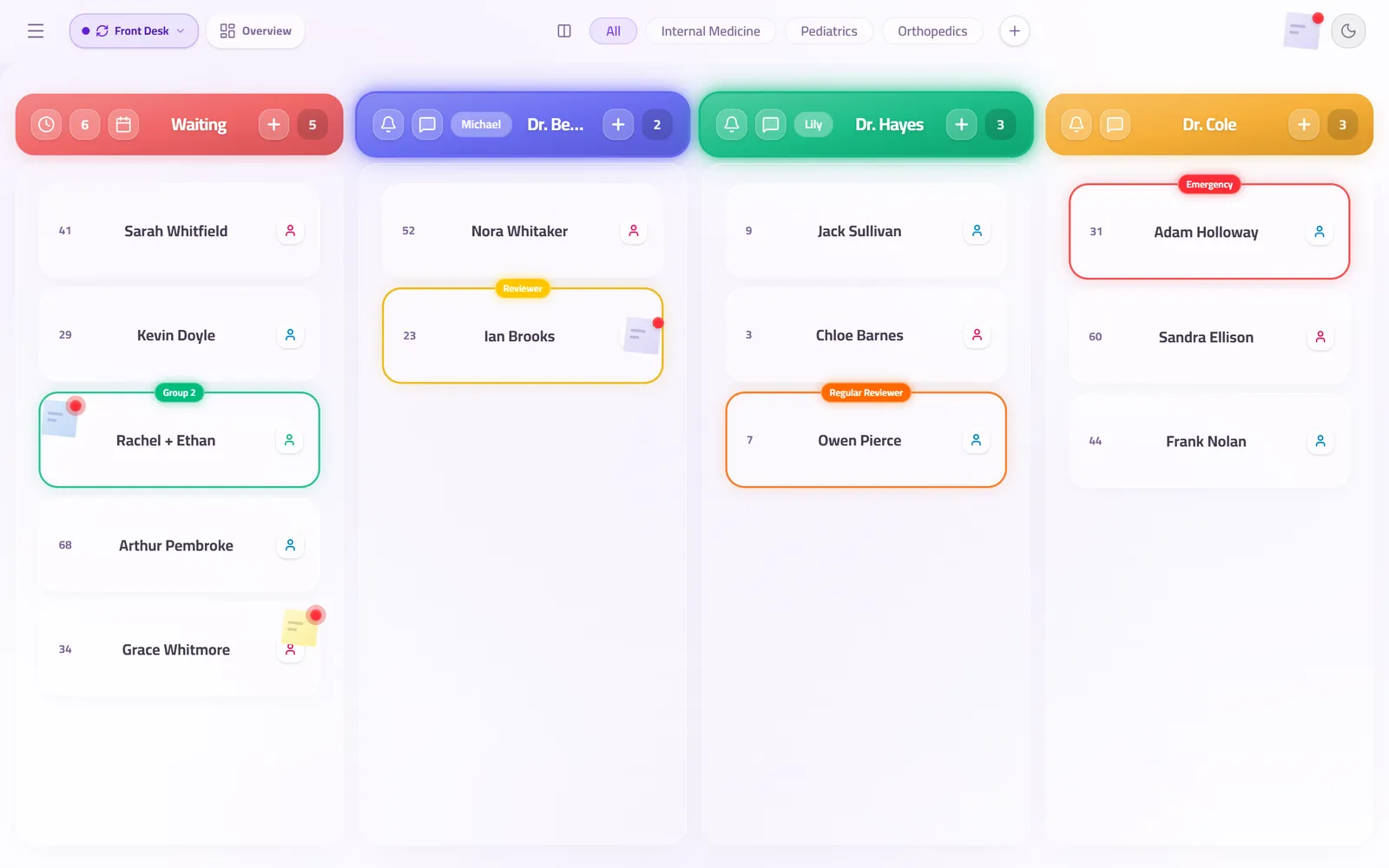
Reception can only move patients it can see. That means one board with every doctor's line on it, where a patient can be moved to another doctor in one step when that is clinically appropriate, and where walk-ins and booked patients share one order rather than two lists.
Plan for patients who arrive early
Patients who arrive long before they can be seen lengthen the measured wait without anyone doing anything wrong, and they fill the room. Two things help: telling patients, when they book, what time to actually arrive; and, when you judge the clinic's performance, counting a booked patient's wait from the appointment time as well as from arrival, so an early arrival is not mistaken for a slow doctor.
Make the wait visible
Show every patient where they stand: on a morning when the wait itself cannot be cut, that is what can still change. In Thompson and colleagues' study of 1,631 emergency department patients, the perceived wait and information about delays predicted satisfaction, while the actual wait did not.
In practice that means a place in line the patient can see without asking — on a screen, or on their own phone — and a call they cannot miss. It also takes the most common interruption away from the reception desk: “how many are before me?”
What worked elsewhere
At the outpatient pharmacy of a comprehensive cancer centre in Amman, a lean-management project cut the wait for prescriptions of fewer than three medicines from 22.3 to 8.1 minutes, and for three or more from 31.8 to 16.1 minutes. Patient satisfaction rose from 62% to 69%. It began with a multidisciplinary team and a structured problem-solving method, not with new equipment.
At a public tertiary hospital in Fujian, China, the monthly average consultation wait fell by 3.49 minutes in the month the interventions began, and the prescription wait by 8.70 minutes. The authors credit the lasting effect to continuous effort by a taskforce with management backing, “rather than a one-time campaign.”
Ways to find out where your wait comes from
Measure it: clinics use one of four methods, listed here from the cheapest to the most complete. A delay nobody can see is a delay nobody fixes.
| Method | Per doctor | Per hour | Every day, with no extra work | Effort |
|---|---|---|---|---|
| A stopwatch and a paper log for a week | Yes, if recorded | Yes | No — a one-off sample | High: someone writes down every time |
| The receptionist's estimate | No | No | No | Low, and unreliable |
| A patient satisfaction survey | No | No | No — asked after the visit | Medium |
| Timestamps from a queue system (QueueCare) | Yes | Yes | Yes | None beyond using the queue |
How QueueCare helps
QueueCare timestamps every check-in and every consultation, so the wait is measured for every patient without anyone writing it down. The day's analytics show the average wait, the busiest hours, the number of patients who waited more than an hour, and — per doctor — the average wait before that doctor saw the patient.
Every doctor's line sits on one reception board, where a patient is moved to another doctor with one drag, and walk-ins and booked patients share one order. Patients follow their place on their own phone and on the waiting-room screen, which calls each name aloud.
Questions clinics ask before they start
What is the single fastest change?
It depends on your numbers, which is why measuring comes first. In the Saudi study, balancing patients across doctors and handling early arrivals had the largest modelled effects; starting the first patient on time is usually the cheapest to try.
Will a queue system shorten the wait by itself?
No. It measures the wait, shows patients where they stand, and makes moving a patient between doctors quick. The minutes change when the clinic acts on what the numbers show.
Should we add another doctor?
Only once the numbers show the problem is capacity rather than distribution. When one doctor's line is long and another's is short, moving patients comes before hiring.
How long is too long?
No longer than 30 minutes is the standard most often cited — the office-wait limit used by the US Military Health System and California's managed-care regulator.
Sources
- Transforming Health Care Scheduling and Access: Getting to Now — Chapter 5, Getting to Now — National Academies of Sciences, Engineering, and Medicine (Institute of Medicine), 2015
- Enhancing outpatient clinics management software by reducing patients' waiting time — Journal of Infection and Public Health (Almomani & AlSarheed), 2016
- Effects of actual waiting time, perceived waiting time, information delivery, and expressive quality on patient satisfaction in the emergency department — Annals of Emergency Medicine (Thompson et al.), 1996
- The Impact of Lean Management Implementation on Waiting Time and Satisfaction of Patients and Staff at an Outpatient Pharmacy of a Comprehensive Cancer Center in Jordan — Hospital Pharmacy (Hammoudeh et al.), 2021
- Reducing waiting time and raising outpatient satisfaction in a Chinese public tertiary general hospital — an interrupted time series study — BMC Public Health (Sun et al.), 2017
- Transforming Health Care Scheduling and Access: Getting to Now — Chapter 2, Issues in Access, Scheduling, and Wait Times — National Academies of Sciences, Engineering, and Medicine (Institute of Medicine), 2015
Related guides
- How do you track average wait times per doctor, per day?
Record two times for every patient — when they arrived and when the doctor started with them — and average the gap by doctor, day by day. A queue system that timestamps both does it automatically; on paper it takes a log sheet at the desk and someone to total it every evening.
- How long should patients wait before seeing the doctor?
No longer than 30 minutes is the standard most often cited: it is the office-wait limit used by the US Military Health System and California's managed-care regulator. Recent US survey data puts the typical waiting-room wait at about 13 minutes. Patients judge a wait less by its length than by whether they know how long it will be.
- How do you reduce crowding in a clinic waiting room?
Give the answer somewhere other than the reception desk. Patients cluster at the desk because it is the only place that knows when their turn is, and they disperse the moment that stops being true.
See it with your own queue in it.
Open the demo and you are standing inside a working clinic — doctors mid-session, patients in line, screens calling names. Nothing to install, nothing to sign.
Open the live demo