How long should patients wait before seeing the doctor?
No longer than 30 minutes is the standard most often cited: it is the office-wait limit used by the US Military Health System and California's managed-care regulator. Recent US survey data puts the typical waiting-room wait at about 13 minutes. Patients judge a wait less by its length than by whether they know how long it will be.
By ATA ATA, practising optometrist · Last updated:
Where the 30-minute figure comes from
The 30-minute figure people quote comes from a 2015 report by the US National Academies of Sciences, Engineering, and Medicine — then the Institute of Medicine — which reviewed how health care is scheduled and accessed, and listed among the standards already in use: office waits “not to exceed 30 minutes unless emergency care is being rendered to another patient.” The standard comes from the US Military Health System and California's Department of Managed Health Care.
The same report is careful about what that number is. It says such benchmarks “have not been validated for national use,” and that each organisation should set its own from its capacity and the demand it faces. Read 30 minutes as a ceiling that says something has gone wrong, not as a target that says everything is fine.
What patients actually wait today
The largest recent figure comes from PatientPoint, which asked 11,009 patients of US physician offices about their most recent visit. The average reported wait in the waiting room was 13.3 minutes in 2024, up from 12.8 in 2023. Patients then spent another 9.6 minutes alone in the exam room before the clinician came in.
The spread between specialties is wide — 10.5 minutes in a dermatologist's waiting room, 21 in a urologist's — and the sample is patients of practices that use PatientPoint's systems, answering from memory. It is a useful reference point, not a standard. In a clinic that takes walk-ins, appointment-based figures are a weaker guide still: nobody was promised a time, so the honest measure starts at arrival.
Why the minutes are only half of it
Long waits cost more than patience. Bleustein and colleagues analysed 11,352 patient surveys from 44 outpatient clinics of one academic medical centre and found that every part of the experience scored lower as waits grew — including confidence in the care provider and the perceived quality of care, not only satisfaction with the visit.
But the minutes are not the whole story. In a study of 1,631 emergency department patients, Thompson and colleagues found that how long patients felt they had waited, and whether they had been told about delays, predicted their satisfaction — and the actual waiting time did not. The setting was an emergency department rather than a clinic, but the finding travels: a patient who can see they are fourth in line, and watch the line move, is waiting for something. A patient who has heard nothing is only waiting.
Setting a target for your own clinic
The National Academies' advice is to set the number locally, from your own demand and capacity, and to keep checking it. In practice that comes down to four steps:
- Measure before you promise. Record every patient's wait, from arrival to the moment a doctor starts with them, for at least two ordinary weeks.
- Look at it per doctor and per hour, not as one clinic average. An average of 20 minutes can hide one doctor whose patients wait an hour between ten and twelve.
- Keep 30 minutes as the ceiling, and count how many patients go over it, not only the average.
- Tell patients where they stand. An honest place in the queue does more for a wait than an optimistic estimate that turns out wrong.
How a clinic can tell patients where they stand
A clinic can tell patients nothing until their name is called, answer when asked, hand out a paper ticket with a number display, or show a live queue on the patient's phone and the waiting-room screen. The options differ in what the patient knows, and in how often reception is interrupted to tell them.
| Option | Patient knows their place | Updates as the queue moves | Patient can leave the room | Reception interrupted |
|---|---|---|---|---|
| Nothing — the name is called when it is time | No | No | No | Often, by patients asking |
| Reception answers when asked | Roughly | Only when asked again | No | Every time someone asks |
| Paper ticket and a number display | Yes, by number | Yes, on the display | No — they must watch the screen | Rarely |
| Live queue on the patient's phone and the waiting-room screen (QueueCare) | Yes | Yes | Yes — the phone shows it anywhere | Rarely |
How QueueCare measures the wait and shows it
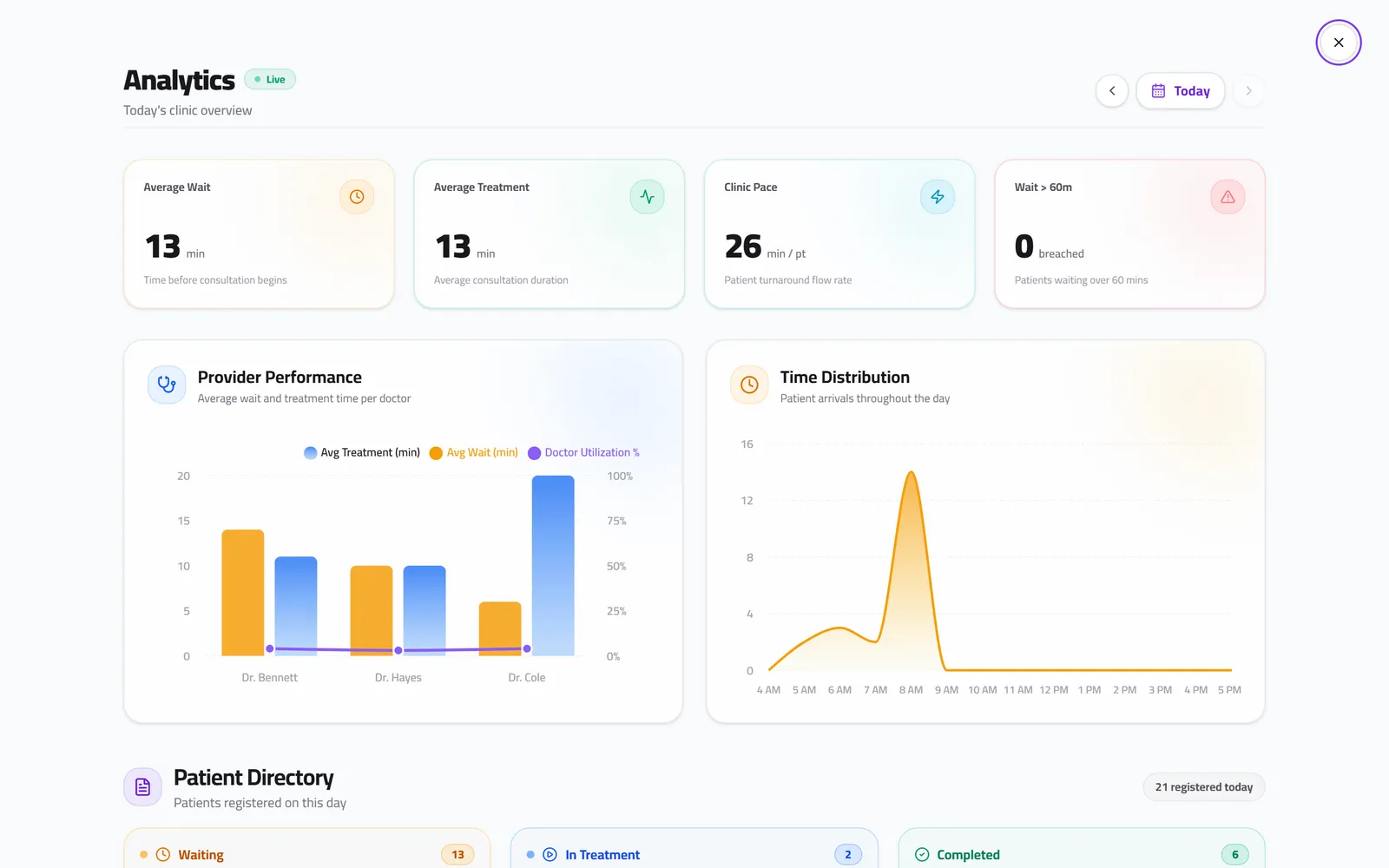
QueueCare records when each patient checks in and when each doctor starts and finishes with them, so the wait is measured without anyone writing it down: it is the time a patient spent in the clinic outside a doctor's room. The day's analytics show the clinic's average wait, the busiest hours, how many patients waited more than an hour, and — per doctor — the average wait before that doctor saw the patient, beside the time the doctor then spent.
Patients see the same queue the desk sees: their place on their own phone after scanning the QR code at the door, and the current call on the waiting-room screen, spoken aloud in Arabic or English.
Questions clinics ask before they start
Is a 15-minute wait reasonable?
By recent US figures it is close to typical: patients reported an average of 13.3 minutes in the waiting room in 2024. Whether it is reasonable in your clinic depends on what patients were told to expect.
Should the wait be counted from the appointment time or from arrival?
The 30-minute standard counts from the scheduled time. For walk-in patients, and for anyone who arrives early, count from arrival — that is the wait the patient actually lives through.
Does telling patients about delays really help?
In Thompson and colleagues' study of 1,631 emergency department patients, information about delays and the perceived wait predicted satisfaction, while the actual wait did not.
What is an acceptable wait in a walk-in clinic?
There is no validated standard. The National Academies' advice is to set one from your own demand and capacity and review it continuously; 30 minutes is a sensible outer limit to measure against.
Sources
- Transforming Health Care Scheduling and Access: Getting to Now — Chapter 2, Issues in Access, Scheduling, and Wait Times — National Academies of Sciences, Engineering, and Medicine (Institute of Medicine), 2015
- What's the average wait time for patients? — PatientPoint, 2025
- Wait times, patient satisfaction scores, and the perception of care — The American Journal of Managed Care (Bleustein et al.), 2014
- Effects of actual waiting time, perceived waiting time, information delivery, and expressive quality on patient satisfaction in the emergency department — Annals of Emergency Medicine (Thompson et al.), 1996
Related guides
- How do you reduce patient wait times at a clinic?
Measure the wait per doctor and per hour first, then fix what the numbers show — usually doctors starting late, patients arriving long before they can be seen, and one doctor's line overloaded while another is free. Showing patients where they stand does not shorten the wait, but it makes it far easier to bear.
- How do you track average wait times per doctor, per day?
Record two times for every patient — when they arrived and when the doctor started with them — and average the gap by doctor, day by day. A queue system that timestamps both does it automatically; on paper it takes a log sheet at the desk and someone to total it every evening.
- How do you reduce crowding in a clinic waiting room?
Give the answer somewhere other than the reception desk. Patients cluster at the desk because it is the only place that knows when their turn is, and they disperse the moment that stops being true.
See it with your own queue in it.
Open the demo and you are standing inside a working clinic — doctors mid-session, patients in line, screens calling names. Nothing to install, nothing to sign.
Open the live demo